A Signature Is Not a Review
Medicare's WISeR program lets software approve prior authorization requests but requires a clinician to deny them. The public record does not yet show whether that clinician has the time, freedom, and independence to review anything. A signature alone is not proof.


Medicare now lets software approve care and requires a person to deny it. No one outside the system can yet see whether that person reviews anything.
A patient waits for a yes
Mary Langley is 70 and lives in Stillwater, Oklahoma. She chose traditional Medicare over Medicare Advantage to stay clear of private insurers deciding what care she could have. In January she was preparing for shoulder replacement surgery, earlier than she had expected, and she told a reporter that her retirement plans "don't feel as certain anymore" (Taylor, 2026).
Her worry has a source. On January 1, 2026, the Centers for Medicare & Medicaid Services (CMS) launched the Wasteful and Inappropriate Service Reduction Model, known as WISeR, in New Jersey, Ohio, Oklahoma, Texas, Arizona, and Washington. It is set to run through December 31, 2031 (CMS, 2026; Congdon, 2026). Under WISeR, six private technology companies review prior authorization requests in traditional Medicare for more than a dozen services, among them steroid injections for pain, nerve stimulators, knee arthroscopy, and skin substitutes (Congdon, 2026). Humata Health handles Oklahoma (LaPointe, 2025). About 60% of Oklahoma Medicare beneficiaries are in traditional Medicare, the part of the program that WISeR reaches (Taylor, 2026).
Dr. Mary Clarke, a Stillwater family physician and past president of the Oklahoma State Medical Association, worries about patients losing steroid injections that manage pain without opioids or surgery. "I think this is a terrible way to tell patients that this is unnecessary for you," she said (Taylor, 2026).
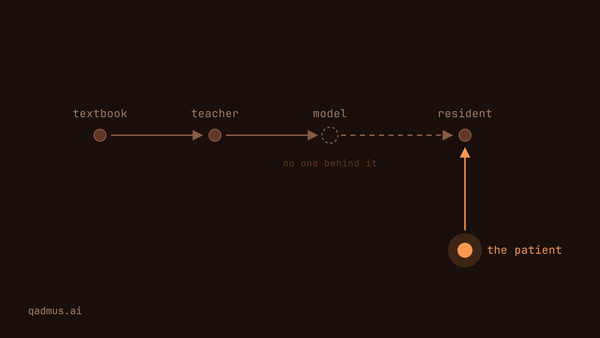
I want to ask one question about this program. When the answer is no, did a person actually look?
The machine may say yes, and a person must say no
WISeR has a safeguard, and it runs in one direction. Software may approve a request on its own when the criteria are met. A denial is different. CMS states that "A human clinician with relevant clinical expertise for selected items and services must review every non-affirmation," CMS's term for a finding that a service does not meet Medicare coverage, coding, or payment requirements, and that denials "cannot be performed solely by technology" (CMS, 2026).
Humata's founder, Dr. Jeremy Friese, described the same design to Oklahoma reporters. The AI cannot deny care, he said, and a request that lacks information or falls in a gray area goes to the company's doctors and nurses. "That's always, always, always a specialized clinician that will make that final call," he said. On its first afternoon, Humata reported on LinkedIn that it had received more than 125 requests, with the software deciding automatically when the criteria were met (Taylor, 2026).
Medicare Advantage plans already work under a similar line. In February 2024, CMS told plans that coverage decisions cannot rest on large data sets alone and must weigh the patient's own circumstances, and federal rules require a physician or other professional with the right expertise to review adverse medical necessity decisions (Rochman, 2024).
I believe these rules are worth having. They also leave the hard question open. A rule that names who must review a denial says nothing about how that review happens. How much time the reviewer has, whether the reviewer can disagree at no cost, and what the reviewer's employer gains from the answer decide whether the review is real. The rule is silent on all three.
What the records show
The Electronic Frontier Foundation (EFF) sued CMS under the Freedom of Information Act in March 2026 and has released the records in batches, about 1,000 pages on September 8 and more than 800 more on October 27 (Cohen, 2026; Cohen & Guariglia, 2026).
The records describe a hurried start. Virtix Health, the vendor for Washington, rejected 53% of the 6,096 requests it processed in the first three months of 2026 (Howie, 2026). CMS raised possibly inaccurate denials with Virtix in a March 17 letter (Cohen & Guariglia, 2026). Two vendors together denied 5,944 requests in that first quarter (Cohen, 2026). CMS expects a decision on a standard request within three days (CMS, 2026), yet one request to Genzeon went unanswered for 83 days (Congdon, 2026). In those first three months, CMS sent requests for information or corrective action plans to at least four of the six vendors (Cohen & Guariglia, 2026).
These numbers need care. The 53% figure belongs to one vendor, in one state, over one quarter, and MedCity News rightly notes that it "doesn't inherently insinuate that the denials were wrong" (Congdon, 2026). EFF itself added that turnaround reflects the whole request path and is not controlled by vendors alone (Cohen, 2026). Virtix blamed many early denials on incomplete documentation. Its corrective action plan closed on August 14, and the company now reports an average turnaround of 1.18 days. It says it now approves almost two thirds of requests on first review, and 84.3% after providers resubmit (Howie, 2026).
What the records leave out matters more to me than what they hold. In particular, EFF says the records offer limited insight into whether human reviewers can override the software's recommendations (Congdon, 2026). Some vendor safeguard details appear to be redacted. One vendor's application promised human-in-the-loop workflows, model monitoring, and audit trails. That same vendor denied more requests than it approved in its first months (Cohen & Guariglia, 2026). We have the promise in writing. We do not have evidence that anyone kept it.
Why a signature may not be a review
A clinician who signs a denial is a real check only under three conditions. The clinician needs time to read the chart, freedom to disagree with the software, and no stake in the answer. The public facts about WISeR, and what we have seen elsewhere, give reason to doubt all three.
Incentives. WISeR vendors receive 25% of the cost of the procedures their reviews avert, and CMS can cut that share by up to 10% for slow or inaccurate decisions (Howie, 2026). EFF reads the program's reporting guide as cutting pay by only 5 to 10% for low quality scores (Cohen, 2026). CMS states that vendors are not paid, or have payments recouped, for denials later reversed on a successful claims appeal (CMS, 2026). If payment rises when care is averted, the vendor's financial interest and the patient's clinical interest are not automatically aligned. KUOW reports that a memo from federal officials acknowledged the payment design could reward denials, and EFF quotes the government as saying the structure gives vendors "an incentive to deny as many claims as possible" (Howie, 2026; Cohen & Guariglia, 2026). I have not seen that memo myself, and I report it as those outlets describe it.
Time. We already know what review can look like when speed is the goal. In 2022, according to ProPublica, Cigna medical directors denied more than 300,000 payment requests over two months using a system called PXDX, spending an average of 1.2 seconds on each case. A Cigna algorithm flagged mismatches between diagnoses and the tests the company accepted for them, and doctors signed off on the denials in batches (Rucker et al., 2023). Cigna called the reporting "biased and incomplete" and said the reviews came after care was given, so they denied payment and not care. The setting was commercial insurance rather than Medicare, and the reviews were of claims rather than prior authorization requests. The case shows that a physician's name can sit on a decision no physician read.
Pressure. In Estate of Lokken v. UnitedHealth Group, families allege that UnitedHealth used a tool called nH Predict to cut post-acute care for Medicare Advantage patients, that more than 90% of appealed denials were reversed, and that staff had to follow the tool "under the threat of termination." The court noted that UnitedHealth denies any use of nH Predict, and none of the allegations has been proven. In February 2025 a federal judge in Minnesota allowed the breach of contract and good faith claims to go forward (McGee, 2025), and a 2026 ruling opened discovery into how the tool was used in practice (Chipman & Graham, 2026).
Human nature. Even a careful reviewer with time and freedom can lean toward the machine. A systematic review of 74 studies found that workload, task complexity, and time pressure all shape automation bias, the tendency to rely too much on automated advice (Goddard et al., 2012). The same review lists training, an emphasis on the user's own accountability, and offering information instead of a recommendation among the factors that reduce it. A denial queue built for speed, where the software arrives with a recommendation already made, matches the conditions that review warns about.
Real review would leave evidence that the public could see. For WISeR, none of it is public yet.
Why appeals do not fix it
Defenders of prior authorization point to appeals. If the first decision is wrong, the reasoning goes, the patient or the physician can challenge it. The numbers tell a different story.
Medicare Advantage gives the best national picture we have. In 2024, insurers made nearly 53 million prior authorization decisions and denied 4.1 million of them, or 7.7%, in full or in part. Only 11.5% of those denials were appealed, and 80.7% of the appeals were overturned in full or in part (Biniek et al., 2026). These are Medicare Advantage figures, not WISeR figures, but they describe Medicare patients facing the same kind of decision.
WISeR shows the same pattern on a smaller scale. Virtix's approval rate climbs from about two thirds to 84.3% once offices resubmit (Howie, 2026), so many first denials do not hold up once someone sends more paperwork. That paperwork falls on physicians and their staff, who are not paid for it, a cost Dr. Clarke raised in Oklahoma (Taylor, 2026). WISeR pays a vendor only once per beneficiary, however many times a request comes back, and the vendor carries the cost of every resubmission. CMS says this rewards getting the first decision right (CMS, 2026). It does nothing for the office that has to send the request again.
Four in five appeals succeeded, at least in part. Yet nearly nine denials in ten are never appealed. In my experience, the people least likely to appeal are the frail, the alone, and those in pain.
In spiritual care, those are often the people we meet. A chaplain sits with a patient who has been told a procedure is not covered and who has no strength left to fight the letter. On paper, CMS says a non-affirmation does not stop a provider from delivering the service and submitting a claim (CMS, 2026). In practice, few offices will perform a service that Medicare has already said it may not cover. That patient never appears in the appeal numbers. That patient goes without, or waits.
Now both sides have agents
The next stage is already on the market. The same kind of software now drafts the request for the hospital and organizes the review for the insurer.
Google Cloud launched Gemini for healthcare in preview on November 10, 2026, with early adopters that include HCA Healthcare, Highmark Health, Northwell Health, and Optum (Hughes, 2026). Healthcare Dive's report does not describe a prior authorization feature, but Google's own product page does. For providers, the agent "Assembles chart evidence aligned to health plan criteria and flags documentation gaps before submission." After a denial, it "drafts a source-cited appeal grounded in the record and plan policy." For payers, it "Checks requests with current policy and coverage guidelines, organized for the reviewer," under the line "Decisions stay with experts" (Google Cloud, 2026). Google says its Epic and Oracle Health connectors are read-only, with "no chart write-back," and that "chart entries, orders, and sign-off stay with clinicians." The page does not say who approves an agent-built request or appeal before it reaches the payer.
Six days later, OpenAI described computer-use agents for healthcare teams. In one demonstration built on synthetic data, the agent prepares "a prior authorization request in the insurer's portal for an authorization specialist to review." In another, Ambience's agent "uses evidence from the patient's chart to prepare a prior-authorization request on an insurer's website," and "When the record is ambiguous, the agent stops and asks the clinician, then waits for approval before submitting" (OpenAI, 2026). The page adds that health systems can set which actions the agent may take, pause it at any point, and keep a step-by-step audit log. It does not say what happens when the record looks clear. It names Cigna Healthcare and CVS Health among its partners, alongside Abridge and Ambience, though the Cigna work it describes helps care managers prepare for member outreach and is not prior authorization review.
I see two ways these tools can go. A tool built to gather the chart evidence that matches a plan's criteria can help a hospital tell a patient's story more completely, so that fewer people wait on a denial that better paperwork would have prevented. The same tool can also teach staff to write the chart toward the criteria, so that the record describes what the plan wants to see rather than the patient in front of them. If the human on each side only signs, the decision becomes an exchange between two machines, with two signatures that tell the patient nothing.
What hospital AI governance committees should ask
Hospitals now sit at both ends of prior authorization. They receive denials shaped by AI, and they are starting to buy AI that writes requests and appeals. Hospitals must also vet the clinical AI they buy, and I will make that case in full next week in "The Vetting Moved to the Hospital." The same duty applies here, and a governance committee can ask plain questions at both ends.
About the payer's or vendor's AI
- How often are our requests denied, by payer and by vendor, and how often do those denials reverse on resubmission or appeal?
- Who reviewed this denial? CMS requires relevant clinical expertise for WISeR denials and allows peer-to-peer review as part of resubmission (CMS, 2026), so we can ask for the reviewer's specialty and a conversation with that reviewer.
- How long did our patients wait, and did any wait cause harm that we can document and report?
- Are we helping patients appeal, especially those least able to do it alone?
About our own AI
- Does a clinician read and sign every request and appeal the tool drafts before it is submitted?
- Do we audit drafted requests against the chart, so that the tool states what the record says and nothing more?
- Do we log which requests and appeals were drafted with AI, so that we can study the outcomes?
A minimum standard for human review
The reviewer has the chart and the time to read it. The reviewer can overrule the software without penalty. The program publishes how often reviewers disagree with the machine. Review that cannot show these three things is a signature.
Patients appear to want the same standard. Healthcare Dive reported a Gallup survey in which "Over half of U.S. adults said that they would be fine with AI tools making clinical decisions about their care, but only if their healthcare provider can review and override those decisions." Their comfort dropped sharply without that oversight (Vaidya, 2026). The survey asked about clinical decisions rather than coverage, yet the point carries. People want someone with the power to overrule the machine, and a signature alone does not show that anyone used that power.
Policy may catch up. EFF has asked Congress to set legal limits on automated decision-making in Medicare (Cohen & Guariglia, 2026), and a Senate effort to repeal WISeR failed 46 to 50 in July (Howie, 2026). In November, the National Governors Association urged states to set safeguards for automated decisions that affect insurance and other essentials, including "human oversight" and "appropriate opportunities to challenge adverse decisions" (National Governors Association, 2026). The questions above do not need to wait for Congress.
Mary Langley chose an earlier shoulder replacement in a year when her retirement no longer felt certain. If a request like hers is ever denied, the letter will carry a clinician's name. That name will tell her someone signed it. It will not tell her that anyone read her chart.
Governance question. When a denial reaches one of our patients, can we show that a person read the chart, had the time to judge it, and was free to disagree with the software? And does the program behind that denial publish how often its reviewers do?
References
- Biniek, J. F., Sroczynski, N., Freed, M., & Neuman, T. (2026, January 28). Medicare Advantage insurers made nearly 53 million prior authorization determinations in 2024. KFF. https://www.kff.org/Medicare/Medicare-advantage-insurers-made-nearly-53-million-prior-authorization-determinations-in-2024/
- Centers for Medicare & Medicaid Services. (2026). WISeR Model frequently asked questions (page last modified September 22, 2026). https://www.cms.gov/priorities/innovation/files/document/wiser-model-frequently-asked-questions
- Chipman, C., & Graham, K. (2026, July 28). AI in insurance coverage decisions: Three practical lessons from Estate of Lokken v. UnitedHealth Group. Freeman Mathis & Gary. https://www.fmglaw.com/insurance/ai-in-insurance-coverage-decisions-three-practical-lessons-from-estate-of-lokken-v-unitedhealth-group/
- Cohen, L. (2026, September 8). New records reveal problems with Medicare's AI prior authorization experiment. Electronic Frontier Foundation. https://eff.org/deeplinks/2026/09/new-records-reveal-problems-medicares-ai-prior-authorization-experiment
- Cohen, L., & Guariglia, M. (2026, October 27). New records obtained by EFF expose more problems with Medicare's AI experiment. Electronic Frontier Foundation. https://www.eff.org/node/112484
- Congdon, J. (2026, November 2). 7 potential problems with Medicare's AI prior authorization experiment. MedCity News. https://medcitynews.com/2026/11/7-potential-problems-with-medicares-ai-prior-authorization-experiment
- Goddard, K., Roudsari, A., & Wyatt, J. C. (2012). Automation bias: A systematic review of frequency, effect mediators, and mitigators. Journal of the American Medical Informatics Association, 19(1), 121-127. https://doi.org/10.1136/amiajnl-2011-000089
- Google Cloud. (2026). AI for healthcare [Product page for Gemini for healthcare]. Retrieved November 14 and November 27, 2026, from https://cloud.google.com/gemini/healthcare
- Howie, S. (2026, October 27). Records show confusion, finger-pointing during AI Medicare rollout. KUOW. https://www.kuow.org/health-care/2026-10-27/records-show-confusion-finger-pointing-during-ai-medicare-rollout
- Hughes, J. (2026, November 11). Google Cloud debuts Gemini for healthcare. Healthcare Dive. https://www.healthcaredive.com/news/google-cloud-debuts-gemini-for-healthcare/874371/
- LaPointe, J. (2025, November 12). Meet the 6 vendors participating in the CMS WISeR Model. TechTarget. https://www.techtarget.com/revcyclemanagement/feature/Meet-the-6-vendors-participating-in-the-CMS-WISeR-Model
- McGee, M. K. (2025, February 14). Court: UnitedHealth must answer for AI-based claim denials. BankInfoSecurity. https://www.bankinfosecurity.com/court-unitedhealth-must-answer-for-ai-based-claim-denials-a-27534
- National Governors Association. (2026, November). Federal and state roles in AI regulation: Statement of principles. https://www.nga.org/wp-content/uploads/2026/11/NGA_AI_Princples_Nov2026.pdf
- OpenAI. (2026, November 16). Advancing computer-use agents for healthcare teams. https://openai.com/index/advancing-computer-use-for-healthcare-teams/
- Rochman, H. L. (2024, February 21). CMS weighs in on the use of algorithms and artificial intelligence in coverage determinations. Manatt Health Highlights. https://www.manatt.com/insights/newsletters/health-highlights/cms-weighs-in-on-the-use-of-algorithms-and-artific
- Rucker, P., Miller, M., & Armstrong, D. (2023, March 25). How Cigna saves millions by having its doctors reject claims without reading them. ProPublica. https://www.propublica.org/article/cigna-pxdx-medical-health-insurance-rejection-claims
- Taylor, J. (2026, January 15). As AI becomes part of traditional Medicare reviews, some Oklahomans worry they'll lose out on care. KGOU. https://www.kgou.org/health/2026-01-15/as-ai-becomes-part-of-traditional-medicare-reviews-some-oklahomans-worry-theyll-lose-out-on-care
- Vaidya, A. (2026, November 13). Patient comfort with AI's clinical decisions tied to provider oversight. Healthcare Dive. https://www.healthcaredive.com/news/patient-comfort-with-ais-clinical-decisions-tied-to-provider-oversight-ga/874623/