Pragmatism and the Learning Health System: What Works, and for Whom?
A sepsis model ran at hundreds of hospitals before Michigan Medicine tested it on its own patients and found it missed two out of three sepsis cases. Pragmatism says an idea is known by what happens when we act on it. This post asks what it means for an AI tool to work, and for whom.

By 2021, a sepsis prediction model built into a major electronic health record was running at hundreds of hospitals in the United States. Sepsis can kill within hours, and the best hope for a patient is early recognition and early treatment. So the promise was easy to believe. The model scored every hospitalized patient every 15 minutes and raised an alert when the score crossed a threshold. Its developer reported that it worked.
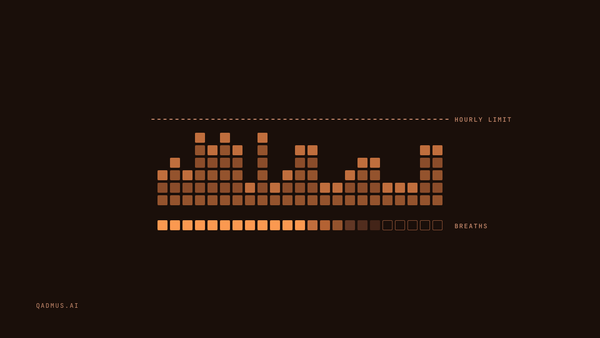
At Michigan Medicine, a team led by Andrew Wong and Karandeep Singh decided to check. They looked back at 38,455 hospitalizations between December 2018 and October 2019, and sepsis occurred in 7 percent of them. The model's discrimination came in at 0.63, where 0.5 is a coin flip, well below the 0.76 to 0.83 its developer had reported in internal documents. It never flagged 67 percent of the patients who developed sepsis, while it raised alerts on 18 percent of all hospitalizations. Of the 2,552 hospitalizations with sepsis, only 183 were flagged by the model in cases where the patient did not receive timely antibiotics, the cases where an alert could have helped most (Wong et al., 2021).
Then COVID-19 arrived. As the pandemic changed who was coming into the hospital, the model began to fire spurious alerts. In the words of a later report, the shift "fundamentally altered the relationship between fevers and bacterial sepsis." In April 2020, Michigan's clinical AI governing committee took the model out of use (Finlayson et al., 2021, p. 283).
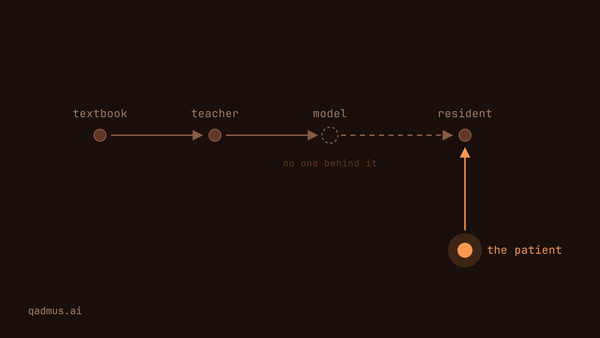
What interests me about this case is what the health system did. It tested a claim against its own patients, found the claim wanting, and changed course again when the world changed. That is the pragmatist idea of knowledge at work. It also sets up the question this post asks. When we say that an AI tool "works," what do we mean, and for whom?
That idea has a name and a history. It is called pragmatism, and it emerged in the United States around 1870, when a group of thinkers began asking a question very much like the one a governance committee asks when it reviews a sepsis model. What happens when we act on it?
The core claim
Pragmatism says that an idea proves itself in action. The meaning and the truth of the idea are found in what happens when we act on it. Catherine Legg and Christopher Hookway put it broadly. Pragmatism "understands knowing the world as inseparable from agency within it" (Legg & Hookway, 2024). Its three founders gave it three different accents.
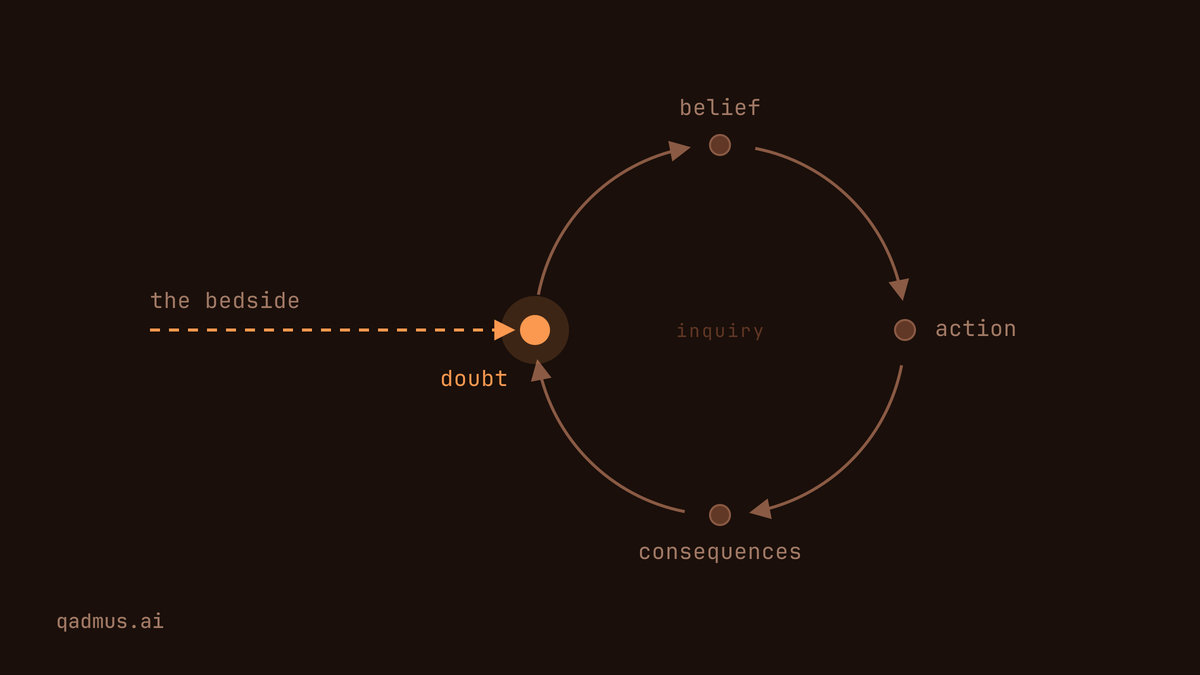
Charles Sanders Peirce started with doubt. In "The Fixation of Belief," he described doubt as "an uneasy and dissatisfied state from which we struggle to free ourselves" and belief as a habit that guides what we do (Peirce, 1877, p. 5). Then he named the work that connects them. "The irritation of doubt causes a struggle to attain a state of belief. I shall term this struggle inquiry" (p. 6). Peirce compared four ways people settle belief. Tenacity holds on to whatever one already thinks. Authority lets an institution decide. The a priori method accepts whatever seems "agreeable to reason." Only the method of science lets something outside of us push back, and Peirce observed that it "is the only one of the four methods which presents any distinction of a right and a wrong way" (p. 12).
A few months later, in "How to Make Our Ideas Clear," Peirce gave the rule that became pragmatism's signature. "Consider what effects, which might conceivably have practical bearings, we conceive the object of our conception to have. Then, our conception of these effects is the whole of our conception of the object" (Peirce, 1878, p. 293). To call a diamond hard is to say what will happen when we try to scratch it. Peirce also tied truth to inquiry carried on over time. "The opinion which is fated to be ultimately agreed to by all who investigate, is what we mean by the truth" (p. 300).
William James carried the idea to a wide public in his 1907 lectures. He asked for the "cash-value" of an idea "in experiential terms." True ideas, he wrote, are those "that we can assimilate, validate, corroborate and verify." For James, "Truth happens to an idea. It becomes true, is made true by events" (James, 1907, pp. 200–201). He also wrote the sentence his critics never let him forget, that "the 'true,' to put it very briefly, is only the expedient in the way of our thinking" (James, 1907, p. 222, emphasis in original).
John Dewey turned pragmatism into a theory of inquiry. He defined inquiry as "the controlled or directed transformation of an indeterminate situation into one that is so determinate in its constituent distinctions and relations as to convert the elements of the original situation into a unified whole" (Dewey, 1938, pp. 104–105). The philosopher John E. Smith summed up the difference between the two men well. Where "Peirce aimed at 'fixing' belief, Dewey aimed at 'fixing' the situation" (Smith, 1978, as quoted in Legg & Hookway, 2024). Dewey even set aside the word "knowledge" for a more modest phrase, "warranted assertibility" (Dewey, 1938, p. 9). And he would not let any conclusion rest for good. "There is no belief so settled as not to be exposed to further inquiry" (p. 8).
How pragmatism shows up in health care AI
The learning health system is pragmatism written into policy. The Institute of Medicine defined it as a system "in which science, informatics, incentives, and culture are aligned for continuous improvement and innovation, with best practices seamlessly embedded in the care process, patients and families active participants in all elements, and new knowledge captured as an integral by-product of the care experience" (Institute of Medicine, 2013, p. 136). Read that definition next to Peirce and Dewey and the family resemblance is plain. Knowledge comes out of practice, goes back into practice, and is never finished.
Ruth Faden and her colleagues at Johns Hopkins saw that this changes the ethics as well as the workflow. Since the 1970s, research ethics has kept research and clinical practice apart. The learning health system, they wrote, proposes that it is "acceptable and indeed essential to integrate research and practice" (Faden et al., 2013, p. S16).
For AI, pragmatism shows up in three practices that a mature governance program already uses.
- Local validation before go-live. A model's published performance is a claim. A health system tests that claim on its own patients before it trusts it, as Michigan did.
- Monitoring after go-live. Performance is watched over time because the world the model learned from keeps changing. Fever during COVID-19 is the clearest example I know.
- Planned change. The FDA now invites makers of AI-enabled devices to describe in advance how a model will be updated, tested, and judged. A "predetermined change control plan" is a manufacturer telling the FDA, before the device reaches market, how the model will change and how each change will be tested. The FDA's guidance says that "one of the greatest potential benefits of AI and ML resides in the ability to improve model performance through iterative modifications, including by learning from real-world data" (U.S. Food and Drug Administration, 2025, p. 3). A plan can even cover changes made for the conditions at a particular site (p. 21).
Each of these treats a model's fitness as something established by use and kept open to revision. That is Dewey's warranted assertibility in a hospital setting.
Strengths
It makes deployment the start of the test. Peirce's method of science is the only one that can be done wrong, and so the only one that can be corrected. A developer's report, an industry award, and a long list of hospitals already using a tool are all forms of what Peirce called authority. They settle belief without asking the world. The Michigan study asked the world.
It gives "validated" a meaning we can check. Apply Peirce's maxim to a word every governance committee hears. A validated model is one that, used on these patients and in this workflow, produces these effects. If a claim of validation implies no difference anyone could observe at the bedside, it has no content. This one rule clears away a great deal of sales pressure.
It expects to be wrong. Dewey's refusal to call any belief finally settled is the right posture for a technology that drifts. A pragmatist health system asks whether a model is safe now, and it keeps asking long after the approval meeting is over.
It places knowledge in a community. Peirce saw that a lone believer cannot hold out for long, because he "will find that other men think differently from him," and so "the problem becomes how to fix belief, not in the individual merely, but in the community" (Peirce, 1877, p. 8). A governance committee, a nursing unit, and a quality team are such communities. Pragmatism gives each of them standing to test what the institution believes.
Weaknesses
"Works" hides a question about the good. Bertrand Russell pressed this point hardest. To know that a belief pays, he wrote, "we must know also what consequences are good, what bad, what consequences are better, and what worse" (Russell, 1910/1994, p. 118). In a hospital, the consequences of a sepsis alert are not abstract. They are the nurse who must respond, the patient who is interrupted, and the patient down the hall who is never flagged at all. A sepsis model can work for a hospital's quality measure and fail the nurse buried in false alarms. Pragmatism tells us to look at consequences. It cannot tell us by itself which consequences count.
Useful is not the same as true. Russell's second objection was that "true" and "useful to believe" mean different things, because we can be persuaded that a belief is useful and still wonder whether it is true (Russell, 1910/1994, pp. 119–120). He granted that "if pragmatists only affirmed that utility is a criterion of truth, there would be much less to be said against their view" (p. 120). Legg and Hookway (2024) argue that some of Russell's attacks were unfair to James. But the point matters for AI. Suppose a model learns that patients on one ward receive more antibiotics, and treats that as a sign of sepsis. The real reason is a ward protocol, and the model stays useful until the protocol changes. A model can be useful for the wrong reasons and keep working until the shortcut breaks.
Learning has a cost, and someone pays it. Faden and her colleagues hold that "just as health professionals and organizations have an obligation to learn, patients have an obligation to contribute to, participate in, and otherwise facilitate learning" (Faden et al., 2013, p. S22). They pair that duty with an obligation to address unjust inequalities (p. S21). Pragmatism on its own has no such pairing. Every model tested in practice is tested on someone, and the patients it misses did not volunteer to be the test. The obligation to learn sits uneasily with the obligation to do no harm, and pragmatism alone cannot adjudicate between them.
The long run is long. Peirce placed truth at the end of inquiry, in the opinion "fated to be ultimately agreed to by all who investigate." Russell later called the hope behind that idea "some very rash assertion" (Russell, 1939, as quoted in Legg & Hookway, 2024). A health system can learn in the long run and still fail the patient in bed tonight.
Inquiry stops when doubt stops. Peirce admitted this himself. Once a firm belief is reached, "we are entirely satisfied, whether the belief be true or false" (Peirce, 1877, p. 6). A dashboard full of green lights ends doubt as well as any proof does. I think this is the weakness a busy hospital should fear most.
Health care stress test
Remember that this is the model that ran at hundreds of hospitals, scored patients every 15 minutes, and never flagged two-thirds of the patients who developed sepsis. Return to that model now and ask the question that closed Post 5. Worked for whom?
On its developer's own evaluation, the model looked good. It may have felt helpful to clinicians who already suspected sepsis, since an alert that agrees with you feels like confirmation. Wong and colleagues point to an earlier study in which the alert fired a median of seven hours after the first lactate level was measured, "suggesting that ESM-driven alerts reflect the presence of sepsis already apparent to clinicians" (Wong et al., 2021, p. 1069). This is confirmation bias made audible. It did not work for the 67 percent of patients with sepsis it never flagged. It did not work for the nurses who received alerts on nearly one in five hospitalizations, most of them for patients who did not have sepsis.
Pragmatism gave Michigan the right test, and Michigan used it well. But the test only works when someone decides whose outcomes count. The Michigan team counted the patients the model missed and the alert burden it created, alongside the headline score. That choice was an ethical judgment, and pragmatism did not make it for them.
As a hospital chaplain, what strikes me is where doubt lives. Peirce insisted that inquiry needs "a real and living doubt" (Peirce, 1877, p. 6). In a hospital, that doubt often belongs to the nurse who has a bad feeling about a patient the alert ignored, or to the family member who says something is different tonight. Chaplains hear these doubts often. Few of them are written down, and fewer still reach a model review. A learning health system that wants to be pragmatist in practice has to give that doubt a way in, before a patient is harmed, not after. The Michigan authors made the same point in plainer technical terms. Governance teams "must be sure that it is easy for clinicians to report concerns about the function of AI systems" (Finlayson et al., 2021, p. 283). I would add that the doubt of families and chaplains belongs in that channel too.
So pragmatism passes the stress test with one condition. It needs a second voice beside it, one that names what counts as working and whose doubt must be heard.
Fit rating
Strong, with a condition. Pragmatism is the native epistemology of the learning health system, and it gives AI governance its best habits. Test locally, monitor always, and treat every approval as provisional. Its weakness is that "what works" needs an account of whose good is served and who bears the cost of finding out. That account has to come from ethics, which is where this series goes after the epistemology movement.
A question for governance teams
When your committee hears that a model "works," whose outcomes were counted, and who decided they were the right ones? Were nurses' outcomes counted? Were the outcomes of the patients who were never flagged counted? Who at the bedside can raise a living doubt about a model already in use, and how does that doubt reach the people with the authority to pull it?
Next, the epistemology of testimony
Pragmatism asks what difference an idea makes when we act on it. The epistemology of testimony asks an earlier question. When a clinician acts on a model's output, she believes something she did not see for herself. C. A. J. Coady and Jennifer Lackey have written carefully about when it is reasonable to believe what others tell us. Post 7 asks whether a machine can testify, and who answers for it when it is wrong.
References
Dewey, J. (1938). Logic: The theory of inquiry. Henry Holt and Company.
Faden, R. R., Kass, N. E., Goodman, S. N., Pronovost, P., Tunis, S., & Beauchamp, T. L. (2013). An ethics framework for a learning health care system: A departure from traditional research ethics and clinical ethics. Hastings Center Report, 43(s1), S16–S27. https://doi.org/10.1002/hast.134
Finlayson, S. G., Subbaswamy, A., Singh, K., Bowers, J., Kupke, A., Zittrain, J., Kohane, I. S., & Saria, S. (2021). The clinician and dataset shift in artificial intelligence. New England Journal of Medicine, 385(3), 283–286. https://doi.org/10.1056/NEJMc2104626
Institute of Medicine. (2013). Best care at lower cost: The path to continuously learning health care in America. The National Academies Press. https://doi.org/10.17226/13444
James, W. (1907). Pragmatism: A new name for some old ways of thinking. Longmans, Green, and Co.
Legg, C., & Hookway, C. (2024). Pragmatism. In E. N. Zalta & U. Nodelman (Eds.), The Stanford encyclopedia of philosophy (Winter 2024 ed.). Metaphysics Research Lab, Stanford University. https://plato.stanford.edu/archives/win2024/entries/pragmatism/
Peirce, C. S. (1877). The fixation of belief. Popular Science Monthly, 12, 1–15.
Peirce, C. S. (1878). How to make our ideas clear. Popular Science Monthly, 12, 286–302.
Russell, B. (1994). Philosophical essays. Routledge. (Original work published 1910)
U.S. Food and Drug Administration. (2025). Marketing submission recommendations for a predetermined change control plan for artificial intelligence-enabled device software functions: Guidance for industry and Food and Drug Administration staff. https://www.fda.gov/regulatory-information/search-fda-guidance-documents/marketing-submission-recommendations-predetermined-change-control-plan-artificial
Wong, A., Otles, E., Donnelly, J. P., Krumm, A., McCullough, J., DeTroyer-Cooley, O., Pestrue, J., Phillips, M., Konye, J., Penoza, C., Ghous, M., & Singh, K. (2021). External validation of a widely implemented proprietary sepsis prediction model in hospitalized patients. JAMA Internal Medicine, 181(8), 1065–1070. https://doi.org/10.1001/jamainternmed.2021.2626