Show Me the Data
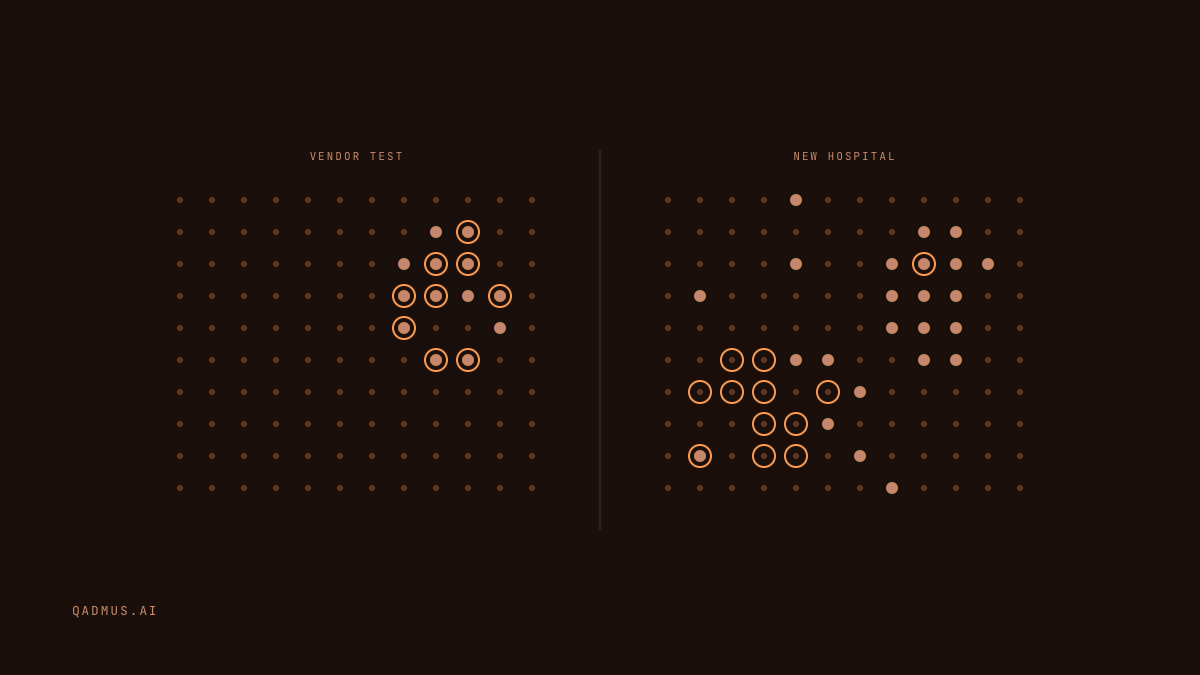
A sepsis model passed the vendor's tests, then missed most cases at a new hospital. Empiricism explains both. Post 2 asks what evidence can prove about a health AI model, what it cannot, and why passing the test is where governance begins, not where it ends.

Post 2 in a series on epistemology and responsible AI in academic health systems. Empiricism, and the problem Hume left at the bedside.
Clinical scene
The AI governance committee meets on a Tuesday afternoon. A vendor presents a sepsis prediction model. The deck is polished. The model was trained on hundreds of thousands of patient encounters, and in testing it separated patients who developed sepsis from those who did not with strong accuracy. A physician asks for the validation data. The vendor provides it. The committee approves the model.
Eighteen months later, the quality team runs its own numbers. The model is catching far fewer cases than the slides promised, and it alerts so often that nurses have learned to dismiss it.
No one in that meeting did anything wrong. They asked for evidence, and they got it. They did exactly what empiricism teaches. That is why this post is worth writing.
The scene is a composite, but its outline follows a real case. The developer of one widely used sepsis model reported an area under the curve between 0.76 and 0.83 in its own documents. When researchers at Michigan Medicine tested the model on 27,697 patients across 38,455 hospital stays, the figure fell to 0.63. The model missed about two thirds of the patients who developed sepsis, and it raised an alert in 18 percent of all hospital stays (Wong et al., 2021).
What empiricism claims
To understand how a committee can do everything right and still approve a model that fails, we have to look at the philosophical habit that governed their meeting.
Empiricism is the view that knowledge comes from experience. What we know about the world, we know because we, or someone we trust, observed it. John Locke put it plainly in 1689. He pictured the mind at birth as white paper, with every idea written on it by experience (Locke, 1689/1975).
David Hume pushed the idea further and found its limit. Hume split knowledge into two kinds. Relations of ideas, such as mathematics, can be known by thought alone. Matters of fact, such as whether this patient will develop sepsis, can only be known through experience. But experience only ever shows us what has already happened. To predict what will happen, we have to assume more. In Hume's words, "all inferences from experience suppose, as their foundation, that the future will resemble the past" (Hume, 1748/1999, Section IV, Part II). Hume asked what justifies that assumption, and he found that nothing does except habit. This is the problem of induction. Nearly three centuries later, no one has fully solved it.
Karl Popper offered the most useful response for science. He argued that no number of confirming cases can prove a general claim, but one clear failure can refute it (Popper, 1959). On this view, good science does not prove theories true. It tries hard to break them, and it keeps the ones that survive.
So the core claim of empiricism, in plain terms, comes in three parts. Trust what has been observed and tested. Be suspicious of what has not. And remember that even the best evidence speaks about the past.
How empiricism shows up in AI practice
Health AI is empiricist by default. Machine learning itself is induction built into software. A model studies past cases and learns patterns that it assumes will hold for future ones. Every prediction a model makes is a bet that Hume's habit will pay off.
Empiricism also shapes how we judge models. Developers hold back part of their data to test the model on cases it has not seen. They report sensitivity, specificity, area under the curve, and calibration. Stronger studies test the model at a different site, which is called external validation. The strongest studies test the model in a prospective trial with real patients, where outcomes are not yet known, which closes many of the ways a model can look better on paper than at the bedside.
Reporting standards now guide this work. CONSORT-AI sets out what a clinical trial of an AI tool must report (Liu et al., 2020). TRIPOD+AI does the same for studies that build or validate prediction models (Collins et al., 2024). Both exist so that readers can check the evidence for themselves.
After deployment, empiricism continues as monitoring. Health systems track whether a model's performance drifts over time, whether alert volumes change, and whether patient outcomes improve.
None of this will surprise readers in academic health systems. It is the same habit of mind that built evidence-based medicine, which Sackett and colleagues described as the careful use of the best current evidence in decisions about individual patients (Sackett et al., 1996). When a governance committee says "show me the data," it speaks the language of empiricism.
Strengths
Empiricism replaces authority with evidence. A vendor's claims, a famous name, or a confident executive do not settle whether a model works. Only testing does. This is a democratic idea at its root, because anyone with the data can check the result.
Empiricism is public. Someone else at another hospital can repeat a validation study. That is how the sepsis model's weakness came to light. Another team ran the test again and published what they found.
Empiricism corrects itself. Because it never claims final proof, it builds in a reason to keep checking. Post-deployment monitoring is empiricism admitting that yesterday's evidence may not hold today.
Empiricism fits the institutions that govern health AI. Regulators, journals, and institutional review boards already speak its language. A governance committee that thinks like an empiricist will be understood by all of them.
I believe empiricism is the strongest school in this series for one reason. It gives a committee a way to say no. Without evidence, the loudest voice in the room wins. With it, even a junior analyst can stop a bad deployment.
Weaknesses and blind spots
Each strength of empiricism carries a matching blind spot. Five matter most for health AI.
The past is not the future. This is Hume's problem in clinical form. A model learns from one population, one era, and one set of workflows. When any of those change, its evidence may no longer apply. Researchers call this dataset shift. Finlayson and colleagues describe how changes in patients, equipment, practice patterns, and even coding rules can quietly break a model that once worked (Finlayson et al., 2021).
The vendor's validation study was true. It was true about somewhere else.
What is measured is not always what matters. Empiricism trusts what can be observed, and so it drifts toward what is easy to observe. Obermeyer and colleagues found that a widely used algorithm treated healthcare costs as a stand-in for health needs. Because less money was spent on Black patients with the same level of illness, the algorithm judged them healthier than they were (Obermeyer et al., 2019). The data were accurate. They measured the wrong thing. The anthropologist Marilyn Strathern put the danger simply, in a line now tied to Goodhart's law. In her words, "When a measure becomes a target, it ceases to be a good measure" (Strathern, 1997, p. 308).
Accuracy is not explanation. Hume noted that we never observe causes, only one event following another. The same holds for models. We can observe their outputs and test their accuracy, but we cannot observe their reasons. The pneumonia model in Post 1 passed some tests while reading hospital markers instead of lungs (Zech et al., 2018). Testing showed that it worked. Only closer study showed why, and the why was alarming.
Observations are shaped by those who make them. The philosopher Norwood Russell Hanson argued that observation is never neutral, because what we see depends on what we already know and expect (Hanson, 1958). In healthcare, people and devices make the data, and both carry bias. Pulse oximeters missed low oxygen levels in Black patients about three times as often as in White patients (Sjoding et al., 2020). Empiricism trusts its instruments. It has no built-in way to ask who calibrated them, and for whom.
What never becomes data does not count. Empiricism weighs the evidence it has. The daughter in Post 1 saw her mother confused at dinner, and no one wrote it down. To a model, that observation does not exist. The spiritual distress a chaplain hears at the bedside is often missing from the chart in the same way. The gaps in the record are not random. They fall hardest on the people whose voices the system already hears least.
The healthcare stress test
Empiricism performs better in some phases of a model's life cycle than in others. It holds up best before deployment and in a model's first months. A committee that requires local validation on its own patients catches many problems that vendor studies miss. Some health systems run a new model silently in the background, comparing its predictions with what actually happens before any clinician sees an alert, a practice sometimes called shadow mode. This is empiricism at its best. It tests the claim here, not somewhere else.
Empiricism strains over time. In 2020, COVID-19 changed who came through hospital doors almost overnight. Finlayson and colleagues report that one health system saw its sepsis alerts surge as the patient mix shifted, and it turned the model off (Finlayson et al., 2021). Monitoring caught the problem, which is to its credit. But it caught the problem after the fact. Evidence always arrives a little late.
Empiricism has little to say where the question is not about frequency. It can tell a committee how often a model is right. It cannot tell the committee what counts as right, whose outcomes matter most, or what a family lost when an alert interrupted a last visit. Those questions need other schools.
So the practical lesson is simple. Use empiricism as the floor, not the ceiling. No model should touch patients without local evidence that it works. But passing that test is where governance begins, not where it ends.
Fit for responsible AI in healthcare
Fit rating. Strong.
Empiricism is necessary for responsible AI in healthcare, and it is not enough. It supplies the evidence that every other school will need, and it gives governance its most useful word, which is no. Its limits are just as clear. It looks backward, it trusts its instruments, and it cannot see what was never recorded.
As a hospital chaplain, I spend much of my work with knowledge that rarely becomes data. A patient's fear, a family's history, and the quiet change a nurse notices before the numbers move are all real. They shape care. Yet they are often missing from the record that trains our models. I believe empiricism is right to demand evidence. I also believe we must keep asking whose experience counts as evidence in the first place.
Next, Bayesian epistemology
Empiricism tells us to gather evidence. It says less about how much any single piece of evidence should change our minds. A positive test means one thing when a disease is common and another when it is rare. Clinicians learn this as pretest probability.
That idea has a philosophical home. Bayesian epistemology treats belief as a matter of degree, updated as new evidence arrives. Ledley and Lusted brought it into medicine in 1959, arguing that diagnosis is reasoning under uncertainty (Ledley & Lusted, 1959). Machine learning speaks this language fluently. Post 3 asks what happens when the starting beliefs, the priors, carry the biases of the records they came from, and whether Bayesian reasoning can help us weigh evidence rather than simply accumulate it.
Governance question
When your committee approves a model, what evidence will it require that the model works on your own patients, and how will you know when that evidence has gone out of date?
References
- Collins, G. S., Moons, K. G. M., Dhiman, P., et al. (2024). TRIPOD+AI statement: Updated guidance for reporting clinical prediction models that use regression or machine learning methods. BMJ, 385, e078378. https://doi.org/10.1136/bmj-2023-078378
- Finlayson, S. G., Subbaswamy, A., Singh, K., et al. (2021). The clinician and dataset shift in artificial intelligence. New England Journal of Medicine, 385(3), 283–286. https://doi.org/10.1056/NEJMc2104626
- Hanson, N. R. (1958). Patterns of Discovery. Cambridge University Press.
- Hume, D. (1999). An Enquiry Concerning Human Understanding (T. L. Beauchamp, Ed.). Oxford University Press. (Original work published 1748)
- Ledley, R. S., & Lusted, L. B. (1959). Reasoning foundations of medical diagnosis. Science, 130(3366), 9–21.
- Liu, X., Cruz Rivera, S., Moher, D., Calvert, M. J., Denniston, A. K., & the SPIRIT-AI and CONSORT-AI Working Group. (2020). Reporting guidelines for clinical trial reports for interventions involving artificial intelligence: The CONSORT-AI extension. Nature Medicine, 26(9), 1364–1374. https://doi.org/10.1038/s41591-020-1034-x
- Locke, J. (1975). An Essay Concerning Human Understanding (P. H. Nidditch, Ed.). Oxford University Press. (Original work published 1689)
- Obermeyer, Z., Powers, B., Vogeli, C., & Mullainathan, S. (2019). Dissecting racial bias in an algorithm used to manage the health of populations. Science, 366(6464), 447–453. https://doi.org/10.1126/science.aax2342
- Popper, K. R. (1959). The Logic of Scientific Discovery. Hutchinson. (Original work published 1934)
- Sackett, D. L., Rosenberg, W. M. C., Gray, J. A. M., Haynes, R. B., & Richardson, W. S. (1996). Evidence based medicine: What it is and what it isn't. BMJ, 312(7023), 71–72. https://doi.org/10.1136/bmj.312.7023.71
- Sjoding, M. W., Dickson, R. P., Iwashyna, T. J., Gay, S. E., & Valley, T. S. (2020). Racial bias in pulse oximetry measurement. New England Journal of Medicine, 383(25), 2477–2478. https://doi.org/10.1056/NEJMc2029240
- Strathern, M. (1997). "Improving ratings": Audit in the British university system. European Review, 5(3), 305–321.
- Wong, A., Otles, E., Donnelly, J. P., et al. (2021). External validation of a widely implemented proprietary sepsis prediction model in hospitalized patients. JAMA Internal Medicine, 181(8), 1065–1070. https://doi.org/10.1001/jamainternmed.2021.2626
- Zech, J. R., Badgeley, M. A., Liu, M., et al. (2018). Variable generalization performance of a deep learning model to detect pneumonia in chest radiographs. PLOS Medicine, 15(11), e1002683.
All citations were checked against their sources on October 30, 2026.